
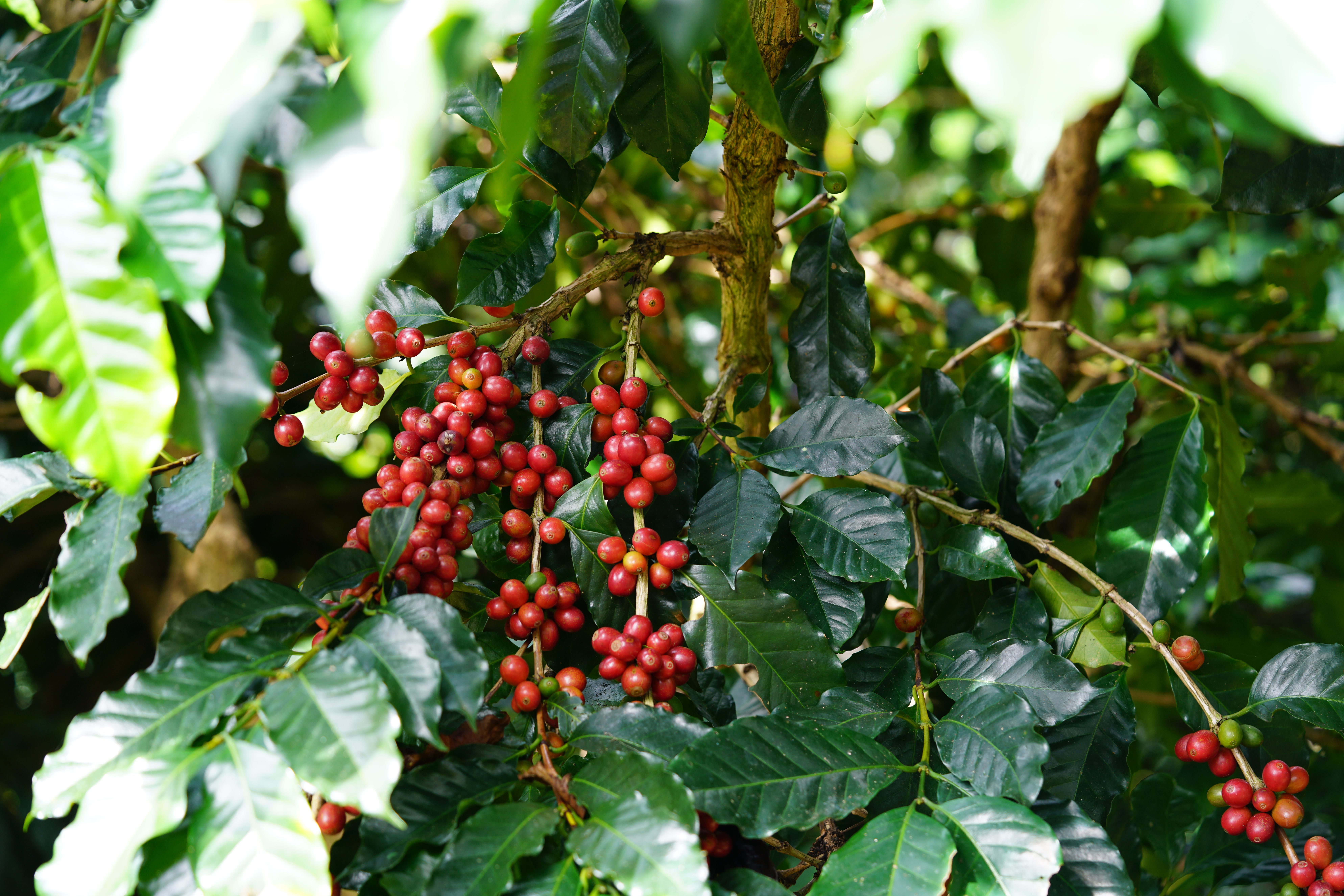
In the Agaete Valley, among green hillsides, fruit trees and mountains that fall towards the Atlantic, one of Gran Canaria’s most singular products is grown: coffee.
It is not the first thing many people imagine when they think of the island. Gran Canaria is often associated with the sea, its mild climate, volcanic landscapes and small white villages. But in the northwest, just a few minutes from Redondo de Guayedra, there is a fertile valley where coffee has been part of the local agricultural history for generations.
Agaete coffee is rare in many ways. It is considered one of the few coffees grown in Europe and one of the northernmost in the world. Its production is small, its harvesting is manual and its connection to the land is deep. This is not a crop designed for mass consumption, but a product of a very specific origin, shaped by the climate, the soil and the rhythm of those who cultivate it.
The Agaete Valley offers unusual conditions for growing coffee outside tropical latitudes. Humidity, mild temperatures, volcanic soil and the natural protection of the mountains create a particularly favourable environment.
Coffee plants grow in the shade of other trees, such as mango, avocado, orange and guava. This coexistence with tropical crops not only protects the plants from the heat, but also shapes the valley’s distinctive agricultural landscape: lush, diverse and surprisingly green.
Here, coffee does not appear in isolation, but as part of the finca. It belongs to an ecosystem where each crop has its place and where agriculture remains on a small, intimate scale.
The history of coffee in Agaete goes back more than 200 years. For a long time, it was a quiet crop, present in the valley’s farms but little known beyond the area.
From the 2000s onwards, Agaete coffee began to gain visibility as a gourmet product and as part of a new way of understanding tourism on the island — one more closely connected to the land, agriculture and local experiences.
Today, visiting a coffee finca in Agaete allows you to discover the full process, from plant to cup. You can see how the coffee plants grow, how the cherries ripen, how they are harvested by hand and how, after careful work, they become roasted coffee.
Part of the value of Agaete coffee lies in its scarcity.
Annual production is limited and depends on an artisanal process that requires time and precision. Each plant produces only a small number of cherries, which, after selection, hulling and roasting, results in much less coffee than one might imagine.
Harvesting is done by hand and in several rounds, as only the ripe cherries are picked. This detail says a lot about the character of the product: no rush, no mass production, no shortcuts.
The result is a smooth, aromatic coffee with its own nuances. A coffee that does not seek to compete in volume, but in identity.
Tasting Agaete coffee is, in a way, tasting the landscape of the valley.
Its flavour is shaped by volcanic soil, humidity, proximity to the sea and the surrounding vegetation in which the plants grow. It is usually worked with medium roasts, aiming to preserve the aromas and maintain a cleaner expression of the bean.
Beyond technique, what makes it interesting is what it represents: a patient, small-scale and deeply local form of agriculture.
For those visiting northern Gran Canaria, going to the Agaete Valley to discover a coffee finca is a simple but very special experience. It does not require elaborate plans. Just a quiet morning, a slow visit and a cup of coffee enjoyed in the place where it is grown.
Agaete is often seen from the sea: Puerto de las Nieves, the natural pools, the promenade, the restaurants by the Atlantic. But the valley offers another reading of the municipality.
Here, the experience is more agricultural, greener and quieter. Among fincas, ravines and tropical crops, coffee helps reveal a less obvious side of Gran Canaria: an island capable of producing something as unexpected as its own rare and recognised coffee.
From Redondo de Guayedra, the Agaete Valley is very close, making it a perfect escape for a quiet morning or afternoon.
A different way to connect with the land, to see the island from within and to discover that, sometimes, a cup of coffee can say a great deal about a place.

At Redondo de Guayedra, life moves at nature’s pace: new beginnings, seasonal harvests and a landscape in constant transformation.
Subscribe to receive curated stories, meaningful experiences and exclusive privileges from our valley.
